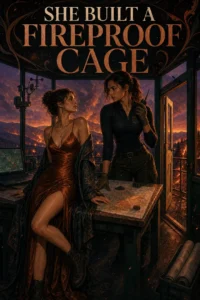
Prologue
by Velvet Crown TalesSave Your Reading History
Create a free reader account to keep your stories and last opened chapters across devices.
The first breath I stole from a siren came in a black glass bottle no larger than my palm.
It had no label. It did not need one. Every captain in Saint Veyra knew what the bottles were for: a mouthful of borrowed weather, a little wind put under cork, enough song to slide a vessel through reefs that had chewed better ships into splinters. The Navy called them navigation privileges. The free ports called them tribute. My crew called them the reason we had not drowned three years ago.
I called them blood money.
The bottle sat between the ledger and my knife on the chart table while rain stitched silver lines across the cabin windows. Beyond the glass, the Vesper Thorn rode at anchor beneath the coral towers of Port Veyra, black sails furled, guns quiet. Her deck should have felt like victory. We had outrun a Navy cutter, taken a customs vault, and come home with enough coin to repair every split plank below the waterline.
Instead, forty of my people were asleep in hammocks that leaked when it rained, and I was counting the names of sailors I had promised to keep alive.
Mara Valeen had given me the bottle with two fingers, as if it might bite.
“One storm passage,” the broker had said. “You can hear it in the glass if you put your ear close.”
I had not put my ear close. I had heard enough voices trapped in too-small rooms.
Now the bottle whispered anyway.
Not words. A rhythm. In, out. In, out. It caught beneath my sternum and pulled at my own lungs until I had to brace both hands against the table.
“Captain?” Thom asked from the doorway.
He was twenty-two, newly promoted and trying hard to look older than the boy I had met stealing oranges off a naval dock. His hair dripped onto the floorboards. “The harbor watch is moving.”
“Toward us?”
“Toward the prison quay.”
That made no sense. The prison quay housed pirates waiting for trial, smugglers waiting for a bribe, and whatever the Navy had dragged out of the sea this week. I picked up the spyglass and climbed to the deck.
The rain had thinned to mist. Lanterns burned along the quay in a hard white row. Between them, the Navy had formed a ring around a cage of coral and iron. Men in dark coats stood well back from it. They kept their hands near their swords, but none of them looked willing to touch the bars.
Something moved inside.
At first I saw only blue-black skin and the long flash of a finned forearm. Then the prisoner lifted his head.
Cael Thorne looked nothing like the jeweled monsters painted on warning maps. No crown. No pearl armor. No theatrical mane of seaweed. He was bare to the rain, wrists cuffed in silver, dark hair plastered over his brow. Gills opened and closed beneath the ribs of his broad chest, each flare catching the lantern light with oil-slick gold. A luminous line pulsed down his side, once, twice, like a second heartbeat.
The whole quay went silent.
I knew his face.
Not because I had met him. Because every survivor of a sunken Navy ship knew it. The Crown-Siren of the eastern shoals. The king who pulled war galleons beneath calm water and left their flags floating above the wreckage. The thing the Admiralty had spent ten years calling a monster whenever they needed men to forget who had sailed into siren territory first.
Thom came to stand beside me. “They caught him?”
“No,” I said. “They bought him.”
The coral cage had been built around an enormous black-glass apparatus bolted to the quay. Brass tubes ran from its center into the sea. A Navy clerk in a white mask lifted a speaking horn and read from a parchment that shivered in the rain.
“By authority of the Saint Veyra Maritime Compact, the voice of the prisoner Cael Thorne is claimed in restitution for twelve sunken vessels—”
Cael smiled.
It was a terrible, beautiful expression. His teeth were too fine at the points. His eyes were fixed not on the clerk, but on the harbor mouth where all the ships sat helplessly at anchor.
Then he drew breath.
The sound that left him was so low I felt it through the deck before I heard it. Every bottle in the Vesper Thorn’s hold began to ring. The sea rose against the pilings. The Navy clerk dropped his parchment. The black glass machine answered with a note of its own, hungry and wrong, and Cael’s throat tightened as if an invisible hook had been driven through it.
The song stopped.
He staggered to one knee. Gold flashed under his skin, then vanished.
I had spent years telling myself I took bottles because refusing would kill my crew. I had spent years making that sentence sharp enough to cut through anything else.
On the quay below, the clerk uncorked a fresh black bottle. A pale ribbon of sound threaded from Cael’s mouth into the glass.
The bottle on my chart table answered from inside the cabin.
Thom looked at me. “Captain, don’t.”
He knew me too well.
“Get the crew ready,” I said.
“For what?”
I watched Cael lift his head again. Through rain, lantern smoke, and a forest of Navy blades, his gaze found mine.
The distance between us should have made that impossible. So should the iron cage. So should the fact that I had never heard his name spoken except as a threat.
But the trapped rhythm in my cabin changed.
In. Out.
In. Out.
His breath reached for mine as if it already knew the shape of my lungs.
“For a theft,” I said.
The Vesper Thorn slipped her moorings under cover of the next burst of rain. We took the prison quay in silence, grapples wrapped in cloth, pistols dry beneath our coats. I went over the rail first, landed between two stunned sentries, and cut the lantern rope before either man could shout. Darkness swallowed the harbor.
In the black, Cael’s body-map bloomed.
It began at his collarbone, molten gold veins crawling across his chest, down his stomach, over the shackles at his wrists. The lines were not random. They curved and crossed with the certainty of coastlines. A route. A warning. A map to something below Saint Veyra that the Navy had paid dearly to keep buried.
Cael looked at it, then at me.
“You are late,” he said, though no sound escaped his ruined throat.
The words arrived in the small locked place behind my ribs.
For the first time in my life, I was afraid of a breath.
Forbidden tales you might also love