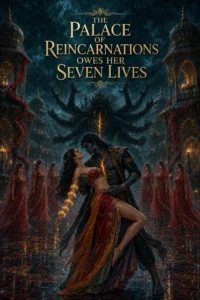
Prologue
by Velvet Crown TalesSave Your Reading History
Create a free reader account to keep your stories and last opened chapters across devices.
The Night Grief Disappeared
Celeste was seven when her mother taught the city not to mourn.
She stood behind the velvet curtain of the Grand Theater while thirty thousand people filled the square outside. Rain glazed the iron bridges and turned every carnival lamp into a trembling jewel. The orchestra had stopped playing an hour ago, but the citizens remained shoulder to shoulder beneath the glass roof, waiting for the queen to name what had happened.
No one said massacre.
The court called it an accident of crowd movement.
The newspapers called it regrettable disorder.
Celeste had seen the bodies.
They had been arranged in rows beneath the eastern tram bridge, shoes paired neatly beside them because the royal clerks believed order made death easier to count.
Her mother knelt and fastened a crown pin into Celeste’s hair.
It was a slender brass thing shaped like a sunburst. Its point touched her scalp.
“Do you know why they are angry?” the queen asked.
Celeste looked through the narrow gap in the curtain. People held black ribbons and portraits of the dead. Their grief moved like weather, pressing against the theater walls.
“Because we killed them.”
Her mother’s hand tightened.
“Because they cannot control what they feel.”
Across the backstage room, three young artisans waited under guard.
Vienne Sol was nine and already impossible to keep on the ground. She sat cross-legged three inches above a trunk, dark curls drifting around her face as if she were underwater. The guards would later call her the dream acrobat, but that night she was only a frightened girl whose sleeping imagination disturbed gravity.
Luc Moreau was thirteen. Copper perfume vials lined the belt at his waist. He had inherited a nose capable of separating sorrow into its smallest scents: rain on wool, extinguished candles, iron beneath skin.
Emil Veyr, twelve, held a blank porcelain mask against his chest. Every strong emotion in the room left a faint color beneath its glaze.
Three functions.
Awaken.
Tint.
Hold.
And Celeste, the receiver, would Choose.
“No,” Celeste said.
Her mother smiled as if she had agreed.
The guards brought Vienne forward.
“Make her feel grief,” the queen ordered.
Vienne shook her head.
A guard seized her shoulder. The floor lost weight around him. He floated upward, boots kicking, and struck the ceiling hard enough to crack plaster.
For one heartbeat, Celeste felt delight.
It was bright and quick and entirely her own.
Luc’s head snapped toward her.
“There,” he whispered. “I can tint that.”
“Do not,” Celeste said.
But her mother had heard.
The queen took a small silver bottle from Luc’s belt and opened it beneath Celeste’s nose. Orange blossom, hot metal, and summer dust flooded her senses. Delight sharpened into exhilaration. The backstage room became vivid enough to hurt.
Vienne laughed despite herself.
Emil’s blank mask flushed gold.
The circuit had begun.
The sensation traveled from Celeste through the crown pin. Outside, thirty thousand mourners gasped together.
Then someone in the square laughed.
Another joined.
Within seconds the entire crowd was smiling beneath black ribbons.
Celeste tore at the pin.
Her mother caught her wrist.
“You see?” the queen said. “Feeling is only a material. Properly handled, it becomes peace.”
“They are still sad.”
“Not once you choose otherwise.”
The queen signaled the guards.
They rolled a brass machine from the shadows. It resembled a loom built around an empty throne. Copper tubes ran from a perfume reservoir to a glass mask suspended above the seat. Steel wires climbed toward the theater rigging in a shape like a crown.
At its center waited a place made for Celeste.
She tried to pull away.
Vienne dropped to the floor and grabbed her other hand.
“Both feet,” the girl whispered. “If I put both feet down, my part stops.”
Luc slipped a silver vial into Celeste’s palm. It smelled of nothing.
“Open this,” he said. “Mine stops.”
Emil showed her the thin fault line he had scored across the porcelain mask.
“Break it,” he said. “The feeling cannot be held.”
They had invented a way out before they knew one another’s names.
Celeste looked at the three signals.
Then at her mother.
The queen’s face was calm, loving, and absolutely certain.
“Place her in the crown,” she said.
The guards moved.
Vienne kicked away from the floor, dragging Celeste into a sudden pocket of weightlessness. Dresses, ribbons, and loose sheets of music rose around them. Luc smashed two perfume vials together. Scarlet anger and violet fear billowed through the air. Emil pressed the mask between his hands, trying to hold both feelings before they tore the room apart.
Celeste floated at the center of it.
She could choose fear.
She could choose anger.
She could choose the forbidden delight still sparkling beneath both.
Outside, the city waited to become whatever she named.
“Grief,” Celeste said.
The word surprised everyone.
She reached for the black ribbons beyond the curtain, the paired shoes beneath the bridge, the parents who had not been permitted to claim bodies. Vienne awakened the image in a dreamlike flash. Luc gave it the scent of rain, wool, candles, and iron. Emil locked it into the mask.
Celeste chose grief.
The theater screamed.
Every pane of glass flashed black. The crowd outside collapsed to its knees as thirty thousand people felt the loss together.
For an instant, truth owned the city.
Then the brass loom woke.
Wires snapped around the floating mask. Copper tubes drank the grief from the air. The machine pulled harder, drawing sorrow from the square, from the theater, from Celeste herself.
The people outside rose.
Their faces were empty.
The mask in Emil’s hands cracked, but the grief did not escape. It flowed into the throne and took the vague shape of a woman seated inside the metal.
The queen watched it form.
“Perfect,” she whispered.
Celeste landed hard. Vienne’s fingers slipped from hers. Luc opened the scentless vial too late. Emil broke the mask, but only white fragments remained.
Celeste searched inside herself for horror.
There was nothing.
She searched for anger, sorrow, even the small delight Vienne had awakened.
Nothing.
Her mother removed the crown pin and kissed the place where it had pierced her.
“One day,” the queen said, “three artists will compete to make you feel again. The winner will place the crown on your head.”
Behind her, the figure inside the throne opened eyes made of blue fire.
Celeste saw it.
No one else did.
“And if they all win?” she asked.
Her mother’s smile vanished.
That was the first emotion Celeste learned to steal from someone else.
Forbidden tales you might also love